Anthropometric Data

Wednesday, March 30, 2011

Bread? Bread! The Great Adventures of Sourdough

Tomorrow marks the official first day of my wild yeast sour dough starter! Boy am I pumped. I went to Whole Foods and bought the necessary ingredients, which just happened to be on sale in the bulk department. Speaking of which, buying in bulk must be a foreign concept to Chicagoland people. I have visited and shopped at several different stores, but have only found but one worth visiting. This particular Whole Foods store is located in Lincoln Park, foodie central. I went crazy and stocked up on dry goods since it is a bit of hike from where I live [...if traveling by bike with several bags of groceries that is].

Anyway, I now have all my ingredients to start my sourdough bread journey. It begins with organic rye flour and water for one day. Then, for the next four days, I feed my seed culture, more flour, only this time all purpose organic flour and more water. After this, I am then ready to prepare the barm, the 'mother' or starter for most basic sourdough recipes. The recipe I fancy to prepare first is a miche style bread from France. None other than Lionel Poilane, a famous French baker, is known for this style of sourdough. His recipe is in the book The Bread Baker's Apprentice, and I highly recommend purchasing this book if you are a serious bread baker yourself. If you want to read a bit more about Mr. Poilane, go to the following website:

http://www.businessweek.com/globalbiz/content/feb2007/gb20070206_625846.htm

Ingredients

1cup (4¼ ounces) dark rye or coarse whole rye (pumpernickel-grind) flour
3cups (13½ ounces) unbleached high-gluten or bread flour
2¼cups (18 ounces) water, at room temperature

Steps

  1. Day 1: Mix the rye flour and ¾ cup (6 ounces) water together in a bowl until they form a stiff ball of dough. Do not worry if the dough is very stiff, but be sure that all the flour is hydrated. Press this piece of dough into a 4-cup measuring beaker and place a piece of tape on the beaker to mark the top of the dough. Cover the beaker with plastic wrap and leave it at room temperature for 24 hours.
  2. Day 2: The dough should not have risen much, if at all, during this time. In a mixing bowl, combine the sponge from Day 1 with 1 cup (4½ ounces) unbleached flour and ½ cup (4 ounces) water, mixing with your hand or a spoon until all the ingredients are evenly distributed. The dough will be somewhat softer and wetter than before. Return this to the beaker, press it down, and replace the old tape with a new piece of tape to mark the spot. Cover with plastic wrap and ferment for 24 hours at room temperature. Do not be put off by the strong, unpleasant aroma of the dough; this will eventually brighten.
  3. Day 3: Check to see if there has been a rise in the dough. There will probably be some fermentation but not a lot, perhaps a 50-percent rise. Regardless, discard half of the starter (or give it to a friend to cultivate) and mix the remaining half with 1 cup (4½ ounces) unbleached flour and ½ cup (4 ounces) water, just like on Day 2. It will be a little wetter. Again, return it to the beaker. It should press down to the same height as on Day 2. Re-tape the beaker to mark the top of the dough, cover, and ferment for 24 hours.
  4. Day 4: The sponge should have at least doubled in size; more is even better. If it is still sluggish and hasn’t doubled in size, allow it to sit out for another 12 to 24 hours. Otherwise, repeat as on Day 3, discarding half of the starter and mixing the remaining half with 1 cup (4½ ounces) unbleached flour and ½ cup (4 ounces) water, returning it all to the beaker as before. Cover and ferment until it at least doubles in size; this may take 4 to 24 hours. It is OK if it triples in size, but because it is now fairly soft and spongelike, it will not be able to sustain that large of a rise without falling. If it falls easily when you tap the beaker, that is the sign that your seed culture is ready to be turned into a barm, or mother starter.

Thursday, March 24, 2011

Momofuku Pork Buns


Well, I purchased the Momofuku book about a couple of months ago, but have been eyeing it up since my friend Bobby showed me his copy. One of the first things which struck me were the steamed pork buns. The actual amount of rendered pork fat is not colossal by any means, but rather scant overall. While making these I knew they were going to be worth the wait, for it took several hours until I could indulge in the soft, delicate buns.

During the fermentation and rest times, I prepared accoutrements playing off Momofuku's standard cucumber pickles, hoisin, pork, and green onion fixings. Instead, I prepared an edamame puree [see below], hoisin, sriracha, leek and pickled carrot.

Edamame Puree:
3/4 cup edamame, frozen is quite alright
pinch salt
pinch sugar
2 tsp soy sauce
1 tsp. wasabi powder
1/8 cup yellow onion
2 tsp. brown rice vinegar
1 1/2 cup water
1 tsp. oil

Saute onion in oil. Once translucent, add remaining ingredients and cook for about 30-40 minutes on medium heat covered with a lid until edamame is quite soft and skins of beans separate. Puree in food processor or blender. You may need to adjust the water content based on how much evaporated in the cooking process.

As for the Momofuku steamed bun recipe...well, I guess you'll have to buy the book. It's well worth the price.

Overall, the recipe was easy; it was just time consuming for the average person. However, I highly recommend trying this one at home. The flavor will send your senses into a frenzy and you'll be sorry you didn't make more.

Thursday, March 17, 2011

Kimchi

According to my Joy of Pickling, "Korean scientists have found that fresh cabbage kimchi is actually more nutritious than unfermented Chinese cabbage....Its levels of vitamins B1, B2, B12 and niacin are twice what they were initially, and its vitamin c level equals that of fresh cabbage."
....And guess what? It tastes amazing! Unfortunately, for this particular recipe, I could not find Korean chili powder, so I substituted chili powder and chili flakes. My lovely friend Kelsey just happens to live in South Korea. I spoke with her while waiting for my cabbage to soak in the salt brine and told her about the kimchi. She was delighted and said I needed to make some for her arrival. Sure I would, just as long as she sends some of that spicy magic powder directly from Korea.

The recipe I used was from the Joy of Pickling, but I did tweak it a bit with more garlic and spice. Before I play around with too many variations, I thought it best to begin with the basics. Once I perfect the base recipe, then I will go on to add things like carrots or daikon radish.

Cabbage Kimchi

3 tablespoons plus 1 teaspoon pickling slat
6 cups water
2 pounds Chinese cabbage, cut into 2-inch squares
1 1/2 tablespoons minced fresh ginger
2 tablespoons Korean ground dried hot pepper (or other mildly hot ground red pepper)
1 teaspoon sugar

1. Dissolve the 3 tablespoons salt in the water. Put the cabbage into a large bowl, a crock or a nonreactive pot and pour the brine over it. Weight the cabbage down with a plate. Let the cabbage stand for 12 hours.

2. Drain the cabbage, reserving the brine. Mix the cabbage with the remaining ingredients, including the 1 teaspoon salt. Pack the mixture into a 2-quart jar. Pour enough of the reserved brine over the cabbage to cover it. Push a freezer bag into the mouth of the jar, and pour the remaining brine into the bag. Seal the bag. Let the kimchi ferment in a cool place, at a temperature no higher than 68 degrees F, for 3-6 days, until the kimchi is as sour as you like.

3. Remove the brine bag and cap the jar tightly. Store the kimchi in the refrigerator, where it will keep for months.

Makes about 1 1/2 quarts.


Sunday, February 27, 2011

Chicago vs. Minneapolis/St. Paul


Well, I have decided to move to Chicago in search of more opportunities and change of scenery. It has been quite challenging on many levels, but feel it is a good decision. While in search of new jobs and apartments, I have discovered a plethora of eating establishments. There are foods from just about every type of cuisine with the addition of Chicago's hot dogs, of course. Hot Doug's is one the more famous local hot dog eateries that I have yet to enjoy. Just about everyday I see people stand in long lines outside, even in the windy, cold weather, waiting for their fill. I was not sure what to think at first, but then I discovered on-line that it was part of the Slow Food Chicago movement (http://www.slowfoodchicago.org). This website is now my go-to page to find participating restaurants. Another restaurant making the list was Green Zebra. My friend Niki, former Sous Chef of Corner Table, and I decided to eat there a couple days ago to indulge in a complete vegetarian affair with fresh burrata topped with crispy lentils, butternut dumplings, mushroom bread pudding and poached egg over smoked applewood mashed potatoes. Yummmmmy. The food was absolutely delightful. Several people had told me beforehand that it is quite possibly the best vegetarian restaurant in Chicago. I guess I will have to eat my way through Chicago and decide for myself.

After my experience at Green Zebra, I could not help but compare the restaurant/food scene of Chicago to Minneapolis/ St. Paul.* The two cities have quite the food scenes going on, each with different high/low lights, thus it is difficult to say which has better food. One thing I do like more about Minnesota and the Twin Cities is the local food movement. I do not have exact stats on how many and how much food the restaurants source locally, but due to the larger number of farms in Minnesota, it would seem more likely. If you think back to a post I wrote a while back on what local means, I mentioned the term 'local' has various definitions depending on who you converse with. Therefore, I must clarify what I mean when I speak about local foods; I believe local foods should refer to the mileage, the distance the food traveled from growth to consumption within a 100-200 mile radius. Most Chicago menus and websites I have browsed print 'local' when they source mostly from Wisconsin, Iowa and Ohio. Yet, there are a fair amount of farms in Illinois, especially in the growth of various berries, asparagus, squash and dairy production, much like MN. Perhaps I have it all wrong; I would love to be proven otherwise that Illinois is well on it's way to providing local foods to local restaurants.

*I guess I should also mention that I had the fortune of eating at the only two 3 star Michelin restaurants in Chicago, Alinea and L2O, since this plays a vital role in comparisons between the cities.

Here are some quick notes on comparing the two foodie destinations:

Twin Cities:
Fewer restaurants (obviously) with less variety
Less creativity, all the food seems alike
Cheaper prices
Ingredients travel a shorter distance in terms of 'local' eating
Easy to go out, [free] parking is available
More country style comfort foods
Quieter
Less busy overall


Chicago:
More restaurants with more variety
Menus differ between restaurants with more creativity
Expensive to eat out
Heaps of community style restaurants
Adventurous eaters, here's your city
Restaurants here have a longer history
Michelin Restaurants: for food and entertainment (might have to explain that in another post)
No parking, unless you want to pay an arm and a leg [taxi]

Of course, these are my observations and options....to each their own.

Tchau tchau for now foodies.

Friday, February 18, 2011

Adapting to the Midwest

It was not long ago when I sat on Lopes Mendes beach, soaking up sunny, 100 degree weather in beautiful Brazil. Often I think of my travels and reminisce on such days when the weather here in Minnesota becomes cold and gray. Thus, to bring the warmth back, I prepared one of my favorite comfort foods. Yesterday I made Split Pea Soup with all natural organic ham from Beeler's Farm in Northwestern Iowa. In my opinion, it is best to make several quarts at once and freeze the bulk for another rainy day, but in small portions. The recipe below makes about 1.75-2 gallons depending on your desired consistency.

Ingredients:
2 1/2 medium yellow onion, diced
1/2 medium yellow onion [kept whole]
5 small/medium carrots, diced
4 celery stalks, diced
14 cloves roasted garlic
4 cups potatoes, diced
14 ounces frozen peas
2 pounds cubed, smoked ham
3 cups shaved brussels sprouts
ham stock
1 1/4 pounds green split peas, rinsed and soaked* [see note]
1 bay leaf
smoked paprika to taste
salt and pepper to taste

Garnish of toasted sliced almonds and celery greens

Preparation:
Rinse the soaked split peas and return to the pot stove filling with water to cover. Add bay leaf and half onion, cooking until peas are tender and naturally fall apart into a puree.

Meanwhile, in a pan, saute in oil [or butter] the diced onion until translucent, then add carrot and celery. Once cooked through, add the potatoes and fill with ham stock just enough to cover the vegetables. When the potatoes are almost soft, add the frozen peas and cook for another few minutes, puree all contents in a food processor until smooth with the roasted garlic. Put in a stock pot and keep on a low simmer. Add to that the cubed ham and shaved brussels sprouts.

Once the split peas fall apart, remove from heat and puree all but three cups for texture. Be sure to remove the bay leaf and half onion before pureeing. Add the peas to the stock pot with the soup. Mix well and heat slowly until the ham warms. Season accordingly with the paprika, salt and pepper until desired taste.

Ladle soup into bowls and garnish with chiffonade celery leaves and toasted almonds.
A nice boule of whole grain bread or Peasant loaf would suite this dish well.

Over the years, I have made several different versions of this recipe. When I have the time and I am moved to Chicago, I will search for past recipes and try them out to see how they compare. In past recipes, I believe I added toasted, ground cumin seeds and spinach.

While in Chicago, I was craving this soup and mentioned to Gil this was one of my favorite soups to prepare. Gil said he could make a better split pea than I, while Lori and Doug stood aside in hopes there would be a cooking show down for them to judge. Perhaps Gil and I will have to prove which one makes a better split pea once I move to Chicago. However, I may have to change a few things since his will be loaded with fat. We all know that fat is flavor, flavor is fat. Who knows, the two combined could be a match made in heaven.

* I prefer to soak the split peas to shorten the cooking time; however, whether it is worth the trouble is up to you. Soaking in cold water for 6 hours can save you 30 minutes in cooking time. Think of it this way, it doesn't take long to soak, so why wouldn't you? All it takes is forethought.
Soaking yellow split peas is another story. It will produce a more viscous puree than unsoaked and will save you one hour of cook time when soaked for 8-10 hours. Be careful though, over-soaking can cause germination and give off-flavors.

Saturday, December 18, 2010

Eating with the Forecast


Hoje: calor calor calor
[Today: hot and humid]

It was far too humid to truly enjoy eating today, so instead, I decided to take part in drinking my lunch, local vinho, wine made by Italian ancestors in Maravilha. I do not believe I mentioned this earlier, but Maravilha in Portuguese means ´Wonderful´, and the vinho undoubtably portrays it to a T. There is most certainly a distinction to their wine as well. It is stronger in acidity, quite dry, has a quick finish, and has a sharp piercing note of grape and garam marsala combined.

Wine is not packaged in a glass bottle, but rather in a plastic bottle resembling that of a soda bottle in the United States. Rarely it is even labeled, and when it is, the wine is only labeled at red, light red, rose, and white.

Among other drinks I have come to enjoy are fresh fruit juices made daily. Yesterday for dessert, I had coconut! It was unbelievably fresh with a rounded fatty milk flavor. Eu gosto!!!

Often it is too hot to eat, so calories are consumed in large volumes by beverage. I love it! There is such an abundance of fruit to enjoy that your options feel limitless. I wonder what other fruits I will enjoy today....
A few days ago, I tried gioba. It´s a yellow skinned fruit with salmon pink flesh and seeds which resemble that of fenugreek, both in texture and appearance. Floral notes of rose with a texture similar to that of pears fill your senses. I think this would be best eaten seedless, for the seeds were not the most pleasant. It was a bit harsh to my mouth, and I did my best to dispose of them. However, there were so many. Later on in the day, I discovered my family had a paste in the fridge, geladeria, made of the same gioba fruit. The flavor was hightened with concentration and no seeds were present. Thus, this fruit requires a small amount of work in order for it to live up to its´full potential in taste [paste and ice cream is more enjoyable]. The lower picture is gioba, while the upper is an unripe persimmon.


Wednesday, December 15, 2010

Community Eating

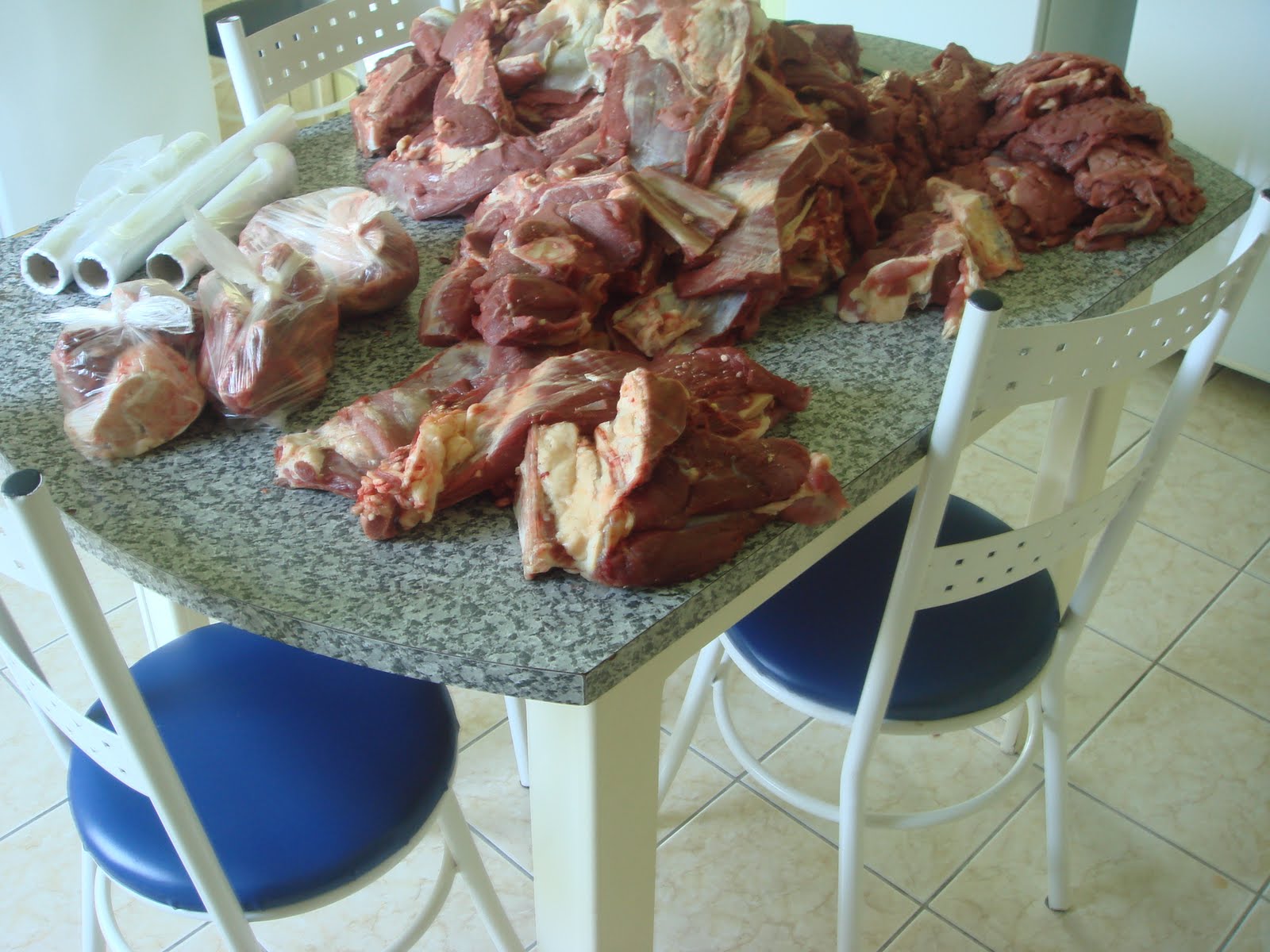
Life in Brazil has shown to be hard, so they raise and grow most of their food. Even the tiniest of properties will have a small piece of land designated for food. Its amazing! The picture you see above is a cow my Brazilian family butchered. They love their meat, especially their beef. Everyday for dinner, we eat a grand meal with some kind of protein, usually containing beef. Along with this are black beans, rice with [green, young] corn, and lettuce. After we eat our lunch, everyone takes a siesta to recover from the meal. However, not I. During siesta, I use this time to write and practice my Portuguese.

When everyone wakes up from their seista, they typically partake in a communal event of drinking yerba mate, a green tea, called chimarráo. The picture below depicts the drinking vessel, special to chimarráo, with a long straw to drink from. The straws have a flattened mesh like sieve to prevent the tea from entering your mouth. Other things may be added for an enhanced flavor [chamomile, fresh bay leaves, etc.]. The means of drinking chimarráo is quite a social event, for there is only one vessel to go around. You pour hot water over the tea on the opposing side from the tea and continue to drink the tea until you finish. Then, you fill it again with water and pass it the next person going around the room. Thus, there is only one vessel per household. I love chimarráo not only for the social engagement, but for the taste too!


Another way to enjoy social eating is by having a churrasco, or BBQ. Below is a picture of beef over an open fire, which is located in the ´garage ´. I say ´garage ´ with question because it´s not the same kind of garage you or I would imagine [if from USA]. In Brazil, the garage is a place to socialize and sit down to enjoy churrasco and chimarráo, not a place for vehicles. Once the food is ready for consumption, the man of the house portions the carna into small portions and puts it on a plate with farinha de mendioca, a starchy potato like flour. Then, one person walks around the room to pass the meat with toothpicks.


These types of social events are exactly what I am in search of with every culture, because food is such an important part of our lives. Food is meant to be enjoyed and experienced with others, not to be abused. Perhaps we can return to our own cultural roots.

I wonder what I will encounter next???